
25 years into the 21st century, it should be no surprise that nations that advance science—through freedom of information, direct investment in basic research, and support for institutions that operate free from political control—lead the way in shaping the future. The benefits are obvious and pervade society. Such nations have added leverage in negotiations around trade and finance, security cooperation, and management of major challenges.
Science is more important to our survival than ever before, so this standard will only be reinforced by high-stakes negotiations in the coming years. It is more important both because we have come to rely on science and engineering to support complex technologies and systems that make our everyday lives safer and more comfortable and because we have disrupted our planet’s natural systems to such a degree we need science to guide us in avoiding the breakdown of those systems.
The breakdown of natural systems also creates a spiral effect of increasing need for science to support everyday wellbeing. As nature erodes and human societies expand, new pathogens are spilling over into animal populations we interact with, and into the human population. The risk of dangerous new disease outbreaks, like the deadly COVID-19 pandemic, is rising. Political rhetoric cannot change that fact; only finely tuned scientific research and discovery, supported by relevant public policy and funding, can prevent the next outbreak from going global.
One recent piece about the United States describes it as “a scientific superpower” that is “destroying itself”. The analysis is based on evidence: While the federal government of the United States undertakes a widespread defunding of scientific research, publishing, and cooperative innovation, it is losing its position as the center of the global science endeavor.
Science always carries a degree of controversy: By its nature, the scientific method requires we ask questions that have not been asked before, challenge orthodoxy, and be open to discovering that long-held assumptions were wrong. When science advances, it proves old thinking wrong, with evidence. This is to everyone’s benefit, but not everyone is willing to accept that the universe is different than we previously thought.
There are industries that presently want to eliminate any kind of scientific inquiry that might provide evidence that they have caused harm, entitling others to redress under law. Obscuring such evidence in one country will only make that same evidence produced elsewhere more valuable. In the end, those same companies will limit their own access to transition guidance and public-sector support, and increase the likelihood that they will face a future collapse in market value.
The nations that lead in the 21st century will be able to:
- Detect disease before symptoms set in;
- Power their economies without pollution;
- Produce and export the lightest-weight, most productive technologies in history, embedding their own quest for prosperity inside the everyday economies of other nations;
- Provide more precise, evolving, and timely weather forecasting and disaster prevention and response measures;
- Save the world trillions of dollars per year in needless costs from disasters and ill health;
- Produce more food than they need and support sustainable nutrition security for other nations;
- Serve as a fiscal and financial anchor for shared prosperity;
- Develop new technologies, medications, and scientific discovery capacity, more quickly, affordably, and effectively;
- Secure long-term prosperity for their people, while counting on others as reliable allies.
Those nations that have walked away from, or failed to develop their science capacity will be dependent on those who lead. Efforts to dismantle U.S. science platforms, academies, initiatives, and funding programs, will make the U.S. far more dependent on China for vital technologies, life-saving medicines, and other cutting edge communications and exploration capabilities.
Some of this will have to do with AI, but AI will not be the lifeblood of the scientific endeavor; it is a tool, and it can be used to make certain facets of very hard problems easier to solve. It might help to accelerate discovery. But science rests on a foundation of unbounded curiosity, which must be supercharged with a commitment to facts and evidence. Without that, discovery is not possible.

One of the great examples of a science mission that could change what is possible in terms of safety, health, and wellbeing on Earth, is the Juno mission, which is now exploring Jupiter. Jupiter is not only our Solar System’s largest planet; it is also the only planet that emits more light than it reflects from the Sun, and it hosts a kind of geology unlike anything we have on Earth.
Complex formations of gases and dense superfluid plasmas shape a landscape that has no ground and should, due to its violence and volatility, not appear solid and stable, and yet we see decade after decade some of the same structures persisting, even as they whip around the planet and are jostled by countless other storms. Jupiter can teach us about fluid dynamics, electromagnetism, gravitational effects, and about planetary and interplanetary physics, in ways no other subject of study can.
The Juno mission aims to answer questions about Jupiter, and about its complex system of moons. Understanding Jupiter will help us to understand how Earth has been so fortunate, compared to neighboring planets, and to understand the evolution of our Solar System. Juno is also positioned to discover signatures of life that could greatly enhance our understanding of how it comes to be, and how it can be protected.
Why does this all matter? Because science is a nonlinear, compounding quest for knowledge. We cannot always predict what the path to great discoveries will look like, but one breakthrough leads to another. If we understand superfluid plasma physics, that might revolutionize how we produce and distribute energy, or how we store information, or how we travel through space. If we understand in precise detail what produces the infrared radiation from Jupiter, we might then discover new ways of harnessing electromagnetic radiation for communicative purposes.
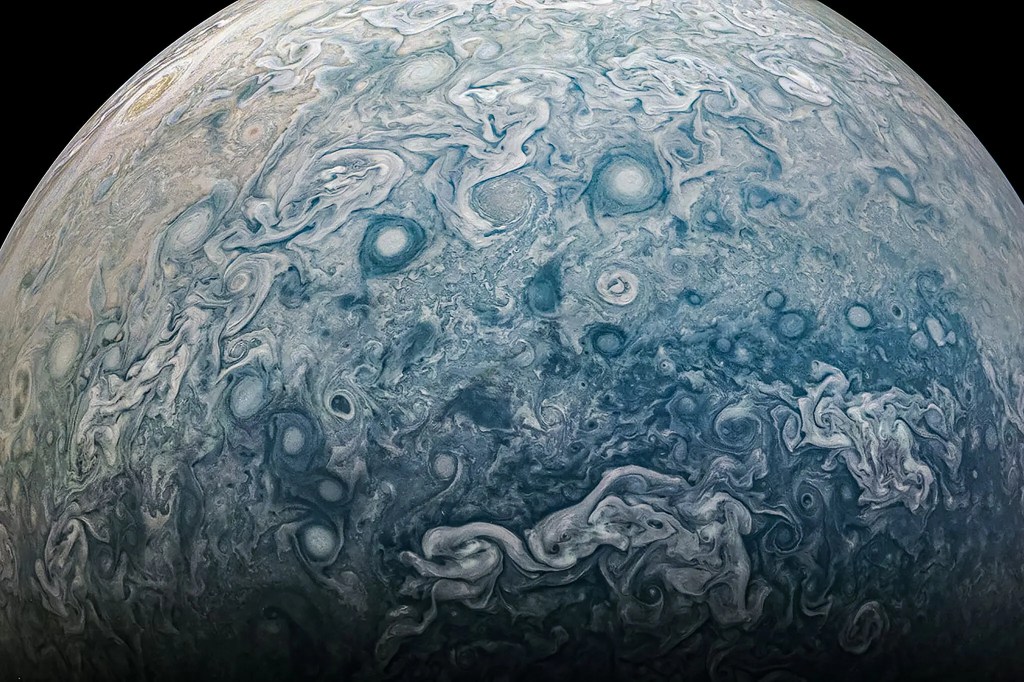
And, there is concern the Juno mission will be abandoned by an administration that does not understand the value of science as such. The same is happening to cancer research, vaccine development, public health data modeling, atmospheric and ocean sciences, and even to weather forecasting, the failure of which would shave a significant amount of every dollar off of household, small business, and municipal budgets.
We must also consider the convergence of parallel forces:
- Science is nonlinear and gives us access to truth, foresight, security, and prosperity.
- Meanwhile, breakdown of natural systems could cost us more than any other failure in coming decades, and costs are rising fast. We need science to point the way to safety.
- The Constitution of the United States prohibits any narrowing of the right to redress, and the International Court of Justice says governments have a duty to reduce climate risk and harm.
- Not knowing enough will cost everyone in society, in ways we can scarcely predict, but which we know are far-reaching and potentially catastrophic.
- Human freedom itself is at stake.
Science is a necessary part of any healthy, functioning society, with a legitimate system of government and an open and innovative economy. The business of nations in the 21st century is to secure freedom, rights, and prosperity, while advancing science.
 Geodesiq Strategies