

The carbon budget is the total amount of heat-trapping pollution (greenhouse gases or GHG) that can be emitted into the atmosphere before we breach 1.5°C. The carbon budget is often treated as an artificial measure, or a rhetorical strategy, for communicating the need to act with urgency. In reality, it is a hard physical limit on financial opportunity—for businesses, industries, and nations.
For decades, policy-makers and industry treated the so-called “social cost of carbon” as a nice-to-have metric that might lead to wider support for climate action. It was actually an effort to quantify the total known and traceable cost of carbon emissions, so the wisdom of that expenditure could be weighed against other priorities. In principle, the social cost of carbon should have been comprehensive, should have accounted for interacting and compounding costs, and should have informed the design of economically efficient pollution pricing strategies.
Industry allies made it a priority to discredit the entire exercise or to secure the lowest possible estimate. Given the massive direct and indirect subsidies they receive, a high social cost of carbon might finally bring the fiscal conservatives and climate advocates together and set up the coordinated unwinding of their market dominance.
No government has ever adopted as its national policy the most comprehensive, integrated, and compounding calculation of climate-related costs for the social cost of carbon. What that means is: No government has yet been able to assess with genuine accuracy the true cost of acting too little or too late to reduce the risk of future climate disruption.
Industry actors and investors dependent on GHG emissions, or global heating pollution (GHP), would have been better served by supporting an honest, detailed, robust social cost of carbon calculation, which could then have driven cooperative planning for a coordinated transition to business models that create more overall value and could still thrive far into the future.
GHP reduction strategies should be comprehensive and account for nonlinear effects. Businesses, local economies, and nations, that discover and deploy strategies to reduce climate pollution and establish sustainable practices as the everyday norm—throughout value chains—will be best positioned to capture future oportunity.
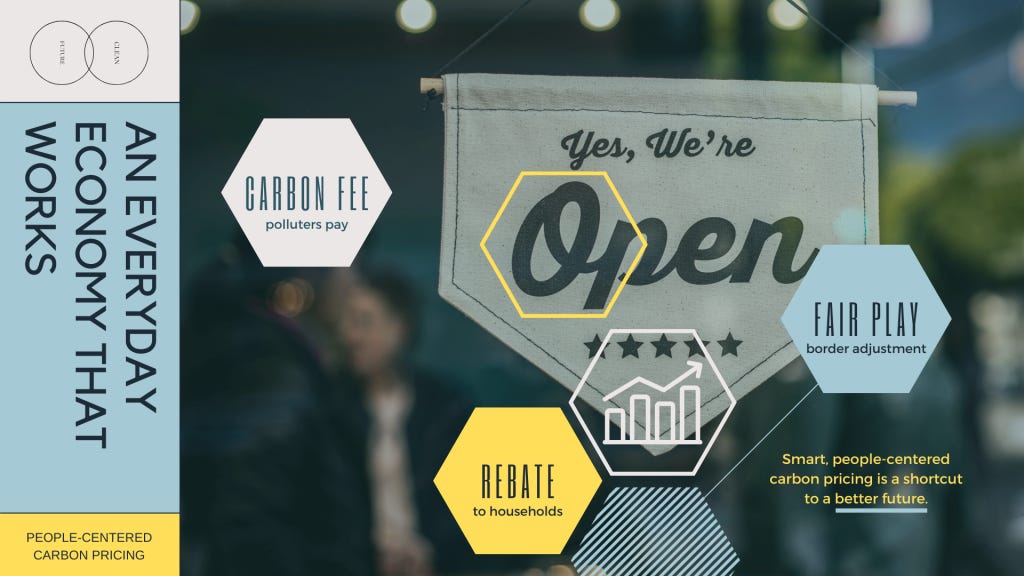
In private, off the record, oil executives have acknowledged this. It is well understood that a high price on carbon, with the right rate of increase over time, stable policy outlook, and special allocations of revenues to reduce macroeconomic friction (cost to consumers), would give them the most investable and secure pathway to playing a leading role in the low carbon economy of the future.
The big problems turn out to be:
- Advantages of incumbency;
- Mistrust of other markets and governments;
- Near universal ongoing incentivization of short-term profit-seeking.
Each of these reduces the appetite for signing up to social cost of carbon metrics or for welcoming stringent climate-related regulations of industry and finance. Nations and industries remain trapped, as a result, in a backward looking mindset that prevents the most cost-effective and organic, economy-wide transition to low-carbon systems and practices.
The carbon budget is not the social cost of carbon. It is not a number that can be adjusted to suit different political perspectives or economic theories. It is a reflection of what our planet does when the composition of its atmosphere is altered. It is a number that talks about human activity (pollution) but refers more directly to geophysical boundaries.
Above 1.5ºC of global heating, critical stabilizing structures of the Earth system may be untenable—including mountain glaciers, polar ice caps, coral reefs and other ecological anchors and carbon sinks, and ocean currents. That means it will become far more difficult to recover from worsening climate disruption, even as costs deplete what resources we have.
According to the Potsdam Institute for Climate Impact Research (PIK), the remaining carbon budget before we breach 1.5ºC is around 161.28 billion metric tonnes of CO2 or equivalent. At this reporting, we are on track to deplete the entire remaining carbon budget in just 3 years, 9 months, and 26 days.
In June, however, the Guardian reported that we have only two yearsremaining of CO2 emissions at current projected levels of consumption. The scientists working on the updated assessment showing a reduced carbon budget found that “continued emissions at current levels would cause human-induced global warming to reach 1.5 °C in approximately 5 years”.
Not only are emissions still rising, with some major economies threatening to reverse or slow urgently needed national climate transition strategies, but the dynamics of climate disruption are compounding in various ways, leading to faster timelines for key thresholds of temperature rise, ice melt, ecosystem degradation, sea level rise, and cost-prohibitive increased frequency of shock events.
Beyond the carbon budget, each increment of climate pollution will add more danger, harm, and cost, than it would have before. As climate disruption dynamics interact and compound each other’s effects, the total economic value lost to climate destabilization will increase in a nonlinear fashion. That means mechanisms suited to today’s rate of rising cost and resilience needs will likely no longer be sufficient within a few years.
Advocates for climate action look at the carbon budget and call for urgent transformational innovation. Polluting industries would like to treat it as an alarmist guess, and hope that it will not play out as the science has shown. The best way to read the carbon budget is to consider what will happen if we do nothing:
- Insufficient, late-adopted, slow-acting efforts to reduce climate risk and build resilience will bring us to a future in which everyday needs are harder to secure, affordably.
- As food systems, clean water resources, infrastructure, and local economies break down, and people migrate in search of safer conditions, national budgets will be stressed in ways that have no precedent.
- Financial rescue mechanisms will not be able to carefully select the handful of most severely needy countries; the universal need for emergency resources could cause financial rescue systms to fail.
- Insurance will not be able to operate in a world of ever-increasing disruption, dislocation, compounding cost, and economic contraction.
- The need for sudden, pervasive, technological transition will increase, even as resources are depleted and costs skyrocket.
The carbon budget is a hard geophysical limit, because beyond 1.5ºC of global heating—the average level of temperature increase across the entire surface of the planet—the cost of action will skyrocket at the same time as the cost of climate impacts is soaring, with financial resources declining. What the carbon budget communicates to us—on the basis of both scientific observation and rapidly worsening real-world disruptions—is that the time for a cost-effective, high-value, transition to sustainable practices is now.

There will never be a more opportune time, from the perspective of national security, fiscal stability, and the goal of a world free of chaos and displacement. It is not the specific “carbon footprint” of a person, household, business, or country, that matters most; what matters is whether you are getting ahead of the curve and positioned to capture the investment that will flow to leaders and innovators.
 Geodesiq Strategies