
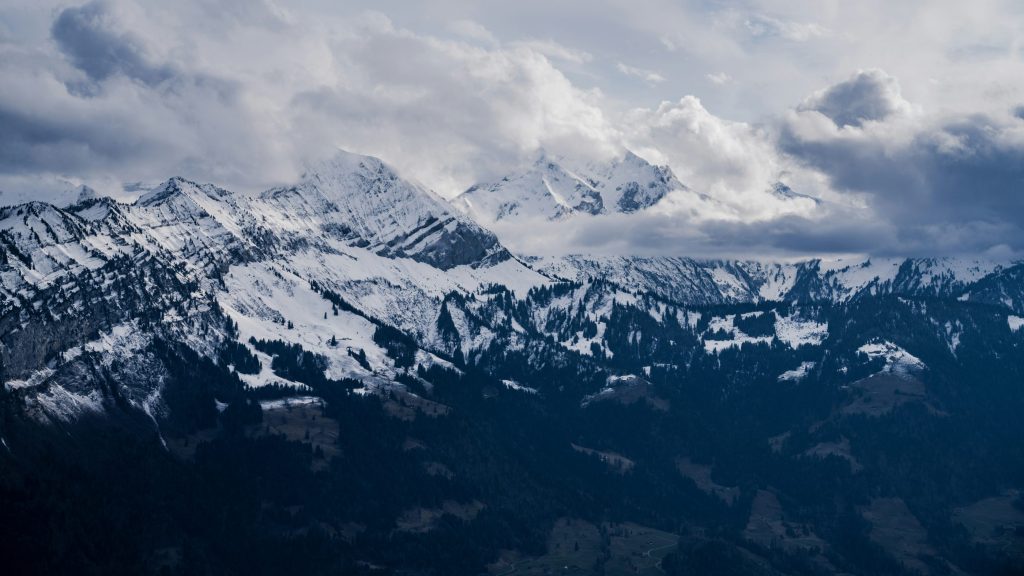
Loss of the mountain cryosphere—glaciers and snowpack—is a climate tipping point we do not talk about enough.
Climate change is complex, because the climate system is complex. It involves atmospheric fluid dynamics, transfer of heat and energy from region to region, and between the ocean and atmosphere. The disruption driven by global heating involves slow-moving but steady changes as well as shock events that cause massive cost and harm.
Tipping points are critical for understanding where we stand in the complex process. A tipping point is a point beyond which it becomes more difficult to return to the previous state of relative climate stability and security. For this reason, we also need to work to avoid crossing those thresholds. Loss of coral reefs and marine biodiversity, loss of climate-stabilizing polar ice sheets, loss of soil carbon and forest biomass, disappearance of permafrost and release of heat-trapping compounds they contain—all of these are potential tipping points that could make it more difficult to return to a stable climate any time soon.
One that we don’t talk about enough, even though it is rapidly becoming a local concern across the world, is the retreat of mountain glaciers. Mountain glaciers serve as headwaters for many of the world’s major rivers. Most of the fresh water people use, in all regions, flows from watersheds that are fed in part by mountain glaciers—even if those glaciers are far away and rarely discussed.

Cities, small villages, farms, and ecosystems across the natural landscape, all need the fresh water that flows from mountain sources. When glacial water is no longer reliably flowing, at the optimal rate, throughout the year, the entire system downstream suffers from reduced access to fresh water. Shock snowloss, either through winter drought or through extreme heat and major melting events, can lead to loss of natural water retention capacity across the landscape, as ecosystems degrade in more arid conditions.
Loss of mountain glaciers could be a major climate resilience tipping point, because once they are gone, ecosystems and watersheds will be fundamentally altered, which will further disrupt climate conditions downstream. As ecosystems degrade or migrate, loss of biomass becomes more likely, which means natural carbon sequestration is also more likely to be degraded.
Such a loss of carbon-based life-forms across a landscape not only makes it harder to reverse climate change; it also means each increment of global heating pollution will be more disruptive, and therefore will generate greater hidden costs. This, in turn, will cause those cost inefficiencies to proliferate through the economy.
- Geophysical impacts, food and water scarcity, and other price shock events, become more likely, necessitating public spending to deal with the compounding harm and cost.
- Jurisdictions that are not prepared—not having put pollution pricing mechanisms in place, so they are wasting money and economic opportunity that others are not—will start to see financial disadvantage they would not have prior to a climate tipping point that affects everyday life.
- Disruption of trade, finance, and local economies, and unsustainable increasing stress on public resources, will have further destabilizing effects.
Last year, UN University published a list of five alarming realities associated with loss of mountain glaciers:
- Due to global warming, glaciers melt at double speed;
- Downstream floods increase when glaciers melt
- Freshwater availability will steadily decline
- 1.9 billion people risk negative effects regarding water resources and livelihoods
- Melting glaciers demand urgent action to cut greenhouse gas emissions
Those 1.9 billion people mentioned in point 4 are those directly impacted—either by immediate water scarcity, or the related impact on the cost of nearly everything, or in terms of the livelihoods available to them and real income value of those wages, given impacts from water scarcity or other downstream effects. Among those downstream effects are food production pressures.
Today is World Food Day. In Rome, people from governments, international agencies, development finance institutions, and researchers, have joined the World Food Forum to examine ways to overcome mounting stresses on global food security.
Mountain glaciers are an excellent example of why fixing climate change is hard. It is difficult to directly protect the glaciers themselves. The solution has to be a change to the human relationship with the climate system, at planetary scale; it has to involve a major reduction in climate-disrupting pollution—everywhere, all at once.

Mountain glaciers are receding, significantly reducing the naturally available fresh water needed for the health of people and ecosystems. The National Oceanographic at Atmospheric Administration (NOAA) reports that “a global analysis published in 2025, combining satellite and ground-based measurements, highlighted the recent acceleration”. That analysis found:
About 41 % of the total loss since 1976…occurred during the last decade from 2015 to 2024… .The strong acceleration of global glacier mass loss is evident over the last years of observations, where 5 (2019, 2020, 2022, 2023, and 2024) out of the last 6 years present the strongest global glacier mass loss ever recorded… . During 2023 alone, the glacier mass loss was about 80 Gt [80 billion metric tons] higher than any other year on record, corresponding to 6 % of the total loss since 1975/1976. In only this 1 year, glacier melt raised sea levels by 1.5 ± 0.2 mm.”
So, glacial melt is already contributing measurably to global sea level rise. Mountain glaciers and snowcaps are more vulnerable than major land-based ice sheets, like those that cover most of Greenland and Antarctica, but this numbers tell an important story. Once the process of accelerated irregular melting starts, only reduced global heating can stop it. That will take time, which means all societies need to be planning for the pervasive disruptive effects of sustained loss of mountain glaciers and snowpack.
A new study, published in the journal Nature Climate Change, has also found that estimates of local cooling over glaciers do not hold up as global heating advances. While microclimate effects can change the rate of warming, they are not sufficient to slow down or stop the accelerating loss of ice. What this means, in simple terms, is that even highly intact mountain glaciers will likely lose their ability to slow local heating by the mid to late 2030s.
Since the UN Framework Convention on Climate Change was established in 1992, with a global commitment to reduce emissions to 1990 levels by the year 2000 and to “prevent dangerous anthopogenic interference with the climate system”, global emissions have never gone down—except for one temporary, involuntary reduction during the COVID shutdowns of 2020. Each day that emissions keep rising puts more strain on everyone going forward: faster transition needed, higher secondary cost per increment of pollution, higher cost of transition, greater risk of sudden market obsolescence, greater risk of fiscal collapse.
We need to talk more about these planetary health tipping points, in local context, with cooperative approaches as priorities, so we can do the work needed to solve the biggest problems facing humanity.
Learn more about the nonlinear compounding costs of climate disruption and its ripple effects at ActiveValue.org

 Geodesiq Strategies